On free will, agency, and determinism
Article 4 of a series: Dialogues with Claude.ai
A friend who has been reading this series wrote that he is interested to see if I will address free will, agency, and determinism in these dialogues. I assured him I would. I will offer here, in Part 1., a scholarly review of these intertwined subjects with the help of Claude.ai. Part 2, to follow, will be a personal essay on my life experiences and what I may have concluded on these subjects, including a foray into religion. This will take time to get right.
Part 1: A Scholarly Review
The Three Positions
The debate about free will has three main positions, each with philosophical defenders, and each with consequences that reach beyond metaphysics into ethics, law, and the texture of daily life.
Hard determinism holds that every event in the universe — including every human decision — is the inevitable consequence of prior causes operating according to physical law. Given the complete state of the universe at any moment, everything that follows is fixed. Your decision to read this sentence was determined by the state of your brain a moment before, which was determined by everything that preceded it, back to the Big Bang. On this view, what feels like choosing is a narrative we construct after the fact — a story we tell about processes that were already settled before we told it.
Libertarian free will — not in the political sense but in the philosophical one — holds that some human choices are undetermined: that a person is the real source of action, not merely a conduit for prior causes flowing through. On this view, something new can enter the causal order — something that could not have been predicted from the prior state of the universe, not because of quantum randomness but because of agency. The self is a real cause.
Compatibilism holds that free will and determinism are not contradictory and can both be true. On this view, the relevant question is not whether your choices are caused — they are, by your own desires, values, and reasoning — but whether they are caused by you, free from coercion or compulsion. A choice made under threat of violence is not free. A choice arising from your own character and deliberation is free, even if that character was itself shaped by prior causes. Compatibilism is currently the dominant position among academic philosophers, though it has vigorous critics.
What Physics Says — And Does Not Say
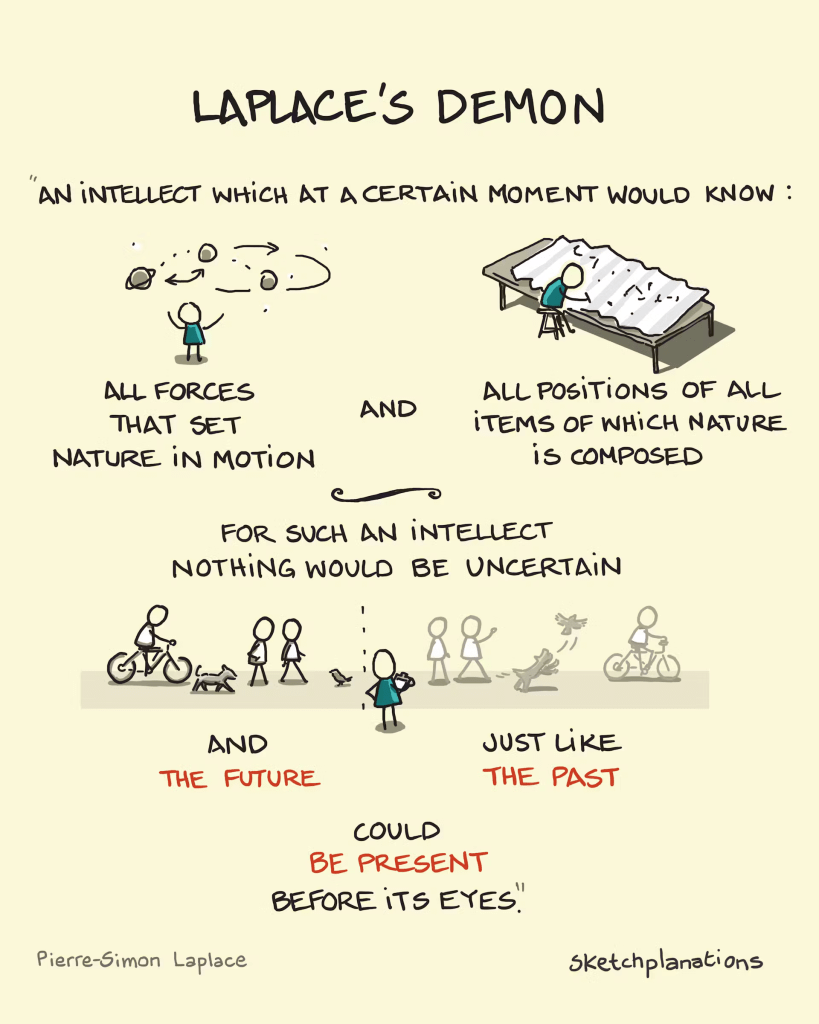
The debate about free will was transformed, or seemed to be, by quantum mechanics. Classical physics was deterministic: given the positions and velocities of all particles at one moment, the future state of the universe was in principle calculable. Laplace’s famous demon — an imaginary intelligence with complete knowledge of the universe’s state — could predict everything that would ever happen.
Quantum mechanics broke this picture. At the subatomic level, events are probabilistic — not merely uncertain because of our ignorance, but indeterminate. An electron does not have a definite position until it is measured. Radioactive decay happens at a statistically predictable rate, but no one can say when a particular nucleus will decay. The universe, at its fundamental level, appears not to be deterministic in the classical sense.
Does this rescue free will? On reflection, not straightforwardly. Random is not the same as free. If a decision were determined by quantum noise in neurons, that is not more comforting than if it were determined by prior causes. Randomness does not produce agency. What libertarian free will requires is not randomness but self-determination — the self as a real cause, not a dice-roll.
David Bohm’s interpretation of quantum mechanics is relevant here. In Bohm’s framework, quantum events are not fundamentally random — they are governed by the implicate order, which is deterministic at a deeper level. The apparent randomness of quantum mechanics is a surface feature of the explicate order. If Bohm is right, the quantum argument for free will dissolves — but so does the classical argument for hard determinism. We are left with a universe governed by a deeper order whose relationship to human agency remains, on Bohm’s own account, open.
What Neuroscience Says — And Does Not Say
In the 1980s, the neurophysiologist Benjamin Libet conducted experiments that shook the free will debate. He asked subjects to flex their wrist whenever they chose, and to note the position of a clock hand at the moment they felt the urge to move. He measured the brain’s electrical activity throughout. What he found was disturbing: a characteristic pattern of neural activity — the readiness potential — began several hundred milliseconds before the subject reported the conscious intention to move. The brain was preparing the action before the person was aware of deciding to take it.
Libet’s experiments have been interpreted, by some, as evidence that conscious decisions are post-hoc narratives — that the brain decides and then tells the conscious mind about it, and the mind mistakes the report for the decision. On this reading, the experience of choosing is real, but the agency it implies is an illusion.
The interpretation has been contested. Libet himself did not conclude that free will is illusory — he noted that subjects could still veto the action after the readiness potential began, suggesting a role for conscious intervention even if not initiation. Later researchers have questioned the experimental design and the inference from a wrist-flex in a laboratory to the complex deliberative choices that define a life. Moving to a new city is not a wrist-flex.
What neuroscience has established is that conscious deliberation is always accompanied by, and in some cases preceded by, neural processes that are not themselves conscious. What it has not established is that those neural processes exhaust the relevant causal story, or that the self — the integrated pattern of values, memories, and reasoning that constitutes a person — is not itself a real causal agent operating through those processes.
Whitehead’s Answer: Agency All the Way Down
Alfred North Whitehead’s framework, introduced in Article 2, offers a different angle on the free will question — one that neither dismisses agency nor requires it to be miraculous.
Recall that for Whitehead, every occasion of experience — at every scale of nature — involves a form of responsiveness: taking account of what preceded it and contributing something to what follows. Each occasion has a tendency toward some outcome rather than others. At the level of a proton, this tendency is minimal and tightly constrained. At the level of a human being, it is elaborate, self-referential, and capable of novelty.
On this view, agency is not a special property that humans possess and rocks do not. It is a feature of reality at every level, varying in degree and complexity. What we call free will in the human case is the most elaborated form of the agency present, in simpler forms, everywhere. The self is a real cause — not because it escapes the causal order, but because it is a participant in it, contributing its own prehension to the next moment of the world.
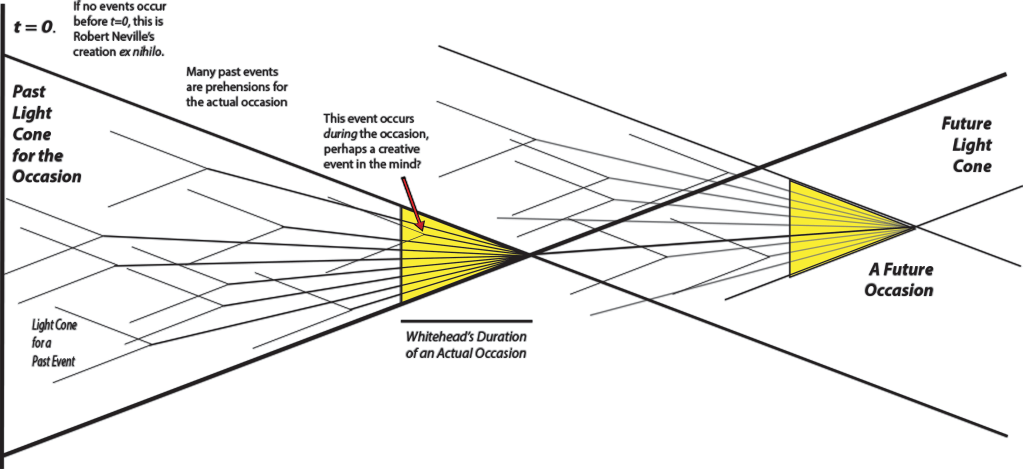
This is compatibilism of a kind — agency and causation are not contradictory — but it is richer than standard compatibilism because it roots agency in the fundamental structure of reality rather than in a particular arrangement of neurons. The self is not reducible to its neural substrate any more than the mitochondrion is reducible to the bacterium it once was. It is a higher-level integration of prehending occasions, with its own causal power operating through but not exhausted by the processes that constitute it.
The Implicate Order and the Question of Destiny
Bohm’s framework raises a harder version of the free will question — one that the preceding articles have been circling without quite naming.
If the implicate order enfolds all its explicate expressions — if the pattern precedes the instance, as Mendeleyev’s periodic table preceded the elements he predicted — does it enfold human lives as well? Is a life already enfolded in the implicate order, unfolding according to a pattern one cannot see and did not choose?
Bohm did not resolve this question. What he did say is that the implicate order is not a fixed program running to a predetermined conclusion. It is a flowing process — the holomovement — in which new patterns can emerge that were not simply present before. Creativity, on Bohm’s account, is real: the universe produces novelty, not merely rearranges what was already there.
Whether human creativity is a form of that cosmic creativity, or merely feels like one, is not something philosophy can currently resolve. What Bohm’s framework does not require is a choice between a universe that is fully determined and one in which agency is a fiction. It leaves room for what might be called a kind of freedom — participation in the unfolding.
Moral Responsibility: What Is at Stake
The free will debate is not merely academic. Its consequences reach into law, ethics, and the foundations of how we treat one another.
In law, criminal responsibility typically requires both an act and a culpable mental state — the defendant must have acted and must have chosen to act, or at least been reckless about the consequences. Hard determinism, taken seriously, would seem to undermine this framework entirely. If the defendant’s action was the inevitable consequence of prior causes — genes, upbringing, neurology, circumstance — in what sense did they choose it? And if they did not choose it, on what basis do we hold them responsible?
This is not a hypothetical concern. Neuroscientific evidence is increasingly introduced in criminal proceedings — evidence of brain abnormalities, genetic predispositions, developmental trauma — as mitigation for behavior that the defendant’s attorneys argue was not freely chosen. The courts have been cautious about accepting strong deterministic conclusions, and rightly so: the inference from ‘this neural pattern is associated with impulsive violence’ to ‘this person could not have done otherwise’ is not as direct as it sometimes appears.
In ethics, the stakes are equally high. Praise and blame, gratitude and resentment, admiration and contempt — these are the responses through which we hold one another morally accountable. The philosopher P.F. Strawson argued, in a celebrated 1962 paper, that these reactive attitudes are so fundamental to human life that no philosophical argument about determinism could rationally dislodge them. We are not spectators of human behavior; we are participants in it, and participation requires holding one another responsible in ways that cannot be suspended by a metaphysical theory.
Strawson’s argument is a form of compatibilism — the reactive attitudes are appropriate because they respond to the quality of will expressed in an action, not to whether that will was itself determined. A person who harms another carelessly is blameworthy because the carelessness reflects their actual values, regardless of whether those values were shaped by prior causes. What matters is not the causal history of the will but the will itself.
This seems approximately right — and it connects to something observable across a long life. The people most worthy of admiration are not those who claimed to act from uncaused freedom, but those whose choices expressed a consistent, hard-won character: integrity maintained under pressure, generosity that cost something, honesty when evasion would have been easier. These qualities feel theirs, and chosen, even though they emerged from a life of accumulated decisions, each one shaping the next.
The Question of Religious Agency
A friend who challenged a statement in an earlier article in this series — a practicing Christian of intellectual gravitas — raised the question of conscious agency directly. If no conscious agent guides the molecular processes we described, what becomes of human agency? And what becomes of divine agency?
The series has been careful to say that science detects no conscious agent in the processes of molecular evolution and natural selection, and requires none to explain what is observed. That is not the same as saying no such agent exists. Science is a method for characterizing mechanism and structure. It is, as noted in Article 1, silent on intrinsic nature — on what things are from the inside. It is therefore silent on agency.
The theological tradition has long distinguished between primary and secondary causation: God as the ground and sustainer of all being, acting through natural processes rather than in spite of them. On this view, the mechanisms of molecular evolution and natural selection are not alternatives to divine agency but expressions of it — the secondary causes through which a primary cause operates. Science describes the secondary causes with great precision. It says nothing about whether a primary cause underlies them.
The implicate order that Bohm proposes as the ground of both matter and mind is not the personal God of Christian theology — but it is not incompatible with such a God either. The question of whether the universe’s tendency toward complexity, life, and mind reflects a deeper intentionality is one that physics cannot currently answer. It remains, as the series has consistently maintained, open.
What Law Has Already Decided
The philosophical debate about free will has not been resolved. But it has been settled — provisionally, pragmatically, and imperfectly — in every legal system that functions. The settlement is instructive, because lawmakers did not arrive at it by resolving the philosophical debate. They arrived at it because law cannot function without it.
Criminal law assumes agency. The foundational concept of ‘mens rea’ — guilty mind — requires that a defendant not merely performed an act but performed it with a culpable mental state: intention, knowledge, recklessness, or negligence. A person who kills while sleepwalking is not guilty of murder. A person who kills under duress is treated differently from one who kills freely. A person who kills because of a severe mental illness that prevents understanding the nature or wrongness of the act may be found not guilty by reason of insanity. All of these distinctions presuppose that there is an important difference between acts that express a person’s own agency and acts that do not — that some causes of behavior are the person’s own, and others are not.
Civil law assumes responsibility. Tort law holds people liable for harms caused by their negligence — their failure to exercise the care that a reasonable person would exercise. The reasonable person standard is a normative construct: it describes what someone should do, which presupposes that people can choose to do otherwise. Contract law assumes voluntary choice: a contract signed under duress or incapacity is voidable precisely because the apparent consent did not reflect genuine agency.
Sentencing law reflects the tension explicitly. The competing purposes of sentencing — punishment, deterrence, rehabilitation, incapacitation — map almost exactly onto the philosophical positions. Punishment presupposes desert, which presupposes agency: you are punished because you chose to do wrong. Deterrence presupposes that people respond to incentives — a soft determinism in which behavior is caused by consequences. Rehabilitation presupposes that people can change — which requires both that prior behavior was caused by something correctable and that future behavior is not yet fixed. Incapacitation is the closest sentencing comes to hard determinism: this person will reoffend regardless, so we contain the outcome. A judge imposing a sentence navigates all four frameworks simultaneously without resolving their underlying philosophical conflict.
The tension surfaces most visibly in three areas. Neuroscientific evidence introduced in criminal proceedings — brain imaging, genetic predispositions, developmental trauma — tests whether causal explanation eliminates responsibility. Courts have held, generally, that it does not: knowing why someone acted as they did is not the same as establishing that they could not have done otherwise. The insanity defense sets a legal threshold for agency — below it, no responsibility; above it, full responsibility regardless of causal factors — a threshold that is philosophically arbitrary but legally indispensable. And addiction cases force courts to distinguish between initial voluntary use, for which responsibility is preserved, and later compelled behavior, for which it is partially mitigated — a hybrid position that preserves agency at the origin while acknowledging causation in what follows.
The implicit position of law is compatibilism: people are caused beings whose causes include themselves.
Their character, values, and deliberation are real causes of their behavior, even though those causes were themselves shaped by prior causes. Holding people responsible for actions that express their own agency — even a causally shaped agency — is both practically necessary and morally appropriate. P.F. Strawson said much the same thing in 1962. The law had been saying it, without knowing his name, for centuries.
Whether this settlement is philosophically satisfying is another question. That it is practically indispensable is not.
What Remains Open
Hard determinism, libertarian free will, and compatibilism each capture something true and leave something important unexplained. Hard determinism captures the causal continuity of nature but struggles to account for the felt reality of deliberation and choice. Libertarian free will captures the reality of agency but has not explained how a self can be a cause without either being determined by prior causes or being subject to chance. Compatibilism captures the practical adequacy of our moral concepts but is challenged by the intuition that causes which go all the way back to the Big Bang are not really ours.
Bohm’s implicate order and Whitehead’s philosophy of organism both suggest that the binary between determined and free is too crude — that reality has a depth and a creativity that neither classical determinism nor naive libertarianism captures. On these views, agency is real, but it is not a violation of the causal order. It is a form of participation in it — present, in varying degrees, at every level of nature.
Whether that is enough to ground the full weight of moral responsibility is a question that philosophy alone cannot settle. It requires a life — and a life, by definition, is what one is in the middle of, not what one can see whole.
Ron Pavellas
Stockholm, 2026
Here are the Articles in this Series:
Dialogue 1. Why Aren’t You a Plant?
Dialogue 2. Does Mind Go All the Way Down?
Dialogue 3. Did Life Begin Here at All?
Dialogue 4a. Did I Choose Any of This?
Dialogue 4b. Who Am I to Propound Upon Free Will?
Final Dialogue: 5. The Flowering Universe


 Dialogues with Claude
Leave a comment